Jungle Carpet Python
Scientific Name: Morelia Spilota Cheynei
Share this Post
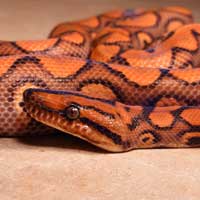
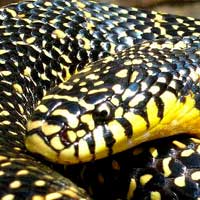
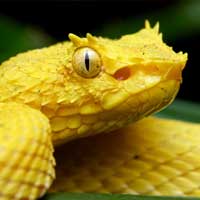
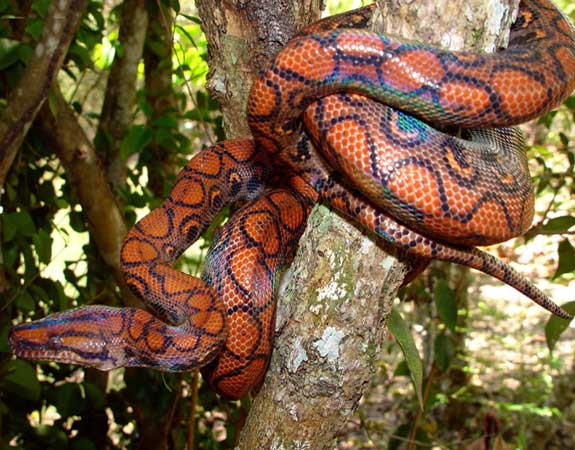
The Jungle Carpet Python is also known as the Rainforest Carpet Python, the Atherton Plateau Carpet Python, the Atherton Tableland Carpet Python, and the Black and Gold Carpet Python. Of the carpet species of python, the Jungle Carpet is the smallest, typically measuring between 2.5″and 3′ 2″. The hatchlings are about 42 centimeters long. Featuring slender bodies, they also have well defined, triangular heads.
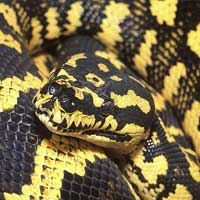
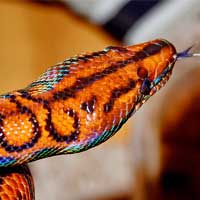
The tails of these snakes are strong and prehensile, with pitted lips and comparatively small scales on their heads. A well defined shape of crossbones and skull is etched upon their heads, in a dark pattern. Behind its eyes and over the lips feature dark bars, with dark lines accentuating the dark eyes. Young adults show the most vivid coloration of bright gold and yellow markings upon a background of black. The rings are typically pale and dark, with blotches being formed by paler rings on its sides and back. These back blotches are elongated, and in younger specimen, feature a more pronounced monochromatic colored effect, normally grey patterns on a black background. When they age, a blackish tint appears on their yellow parts, also turning to a sooty appearance. A number of Jungle Carpet Pythons spot a pale stripe down their backs, while others have exhibit zigzag stripes, yet in others; the stripes are more or less straight. Those with this line proffer a break or imperfection visible on this line. Others will have lines that appear as dorsal blotches that are connected. The yellow hue is more common in adults than in juveniles, instead they feature a tan color that is light until they mature.
Jungle Carpet Pythons Are Beautiful Creatures
Facts About Jungle Carpet Pythons
Geographic Location
Varieties of sub species of this species of python are found scattered throughout New Guinea and Australia. The brighter of the specimens, known as Jungle Carpet, are found in the Northern areas of Australia. Darker specimens are normally found in the more southern and central areas of the northern part of Australia.
Habitat
Carpet pythons are located in a host of habitats, from wooded savannahs to grasslands, tree perches, and heavily forested areas of the sub tropical rainforests in Australia.
Behavior
Comparatively high stung in relation to other carpet python species, also as compared to other snakes of an arboreal nature. Experienced pet keepers, rather than young children and beginner keepers best keep them captive. When young, jungle carpet pythons tend to be highly sensitive against potential threats, which lead to quite a few bites at its juvenile stage. With maturation, the snake will bite a lot less once it senses that the owner as a friend.
Reproduction
Most carpet pythons are annual breeders, and cycling them on a yearly basis will yield the best results. Gradually reducing the nighttime low temperatures (aim for 65 to 70 degrees Fahrenheit) and daily photoperiod (10 to 12 hours) will start the breeding process, usually in the fall. Daytime basking temperature should remain at least 90 degrees. Females should be given some extra meals prior to breeding season to build up some fat reserves that will be needed for egg formation and oviposition. This is especially critical when allowing the female to incubate her own eggs (maternal incubation), a unique behavior in carpet pythons that can be exciting to witness. While females are best kept slightly plump at the beginning of breeding season, males should be kept lean and muscular for optimal breeding vigor. Males will often stop eating during breeding season and display cruising behavior in their cage, relentlessly crawling in pursuit of a mate.
Captivity
Life expectancy for the Jungle Carpet Python while kept in captivity is approximately twenty to thirty years. They are moderately easy to care for, and are available readily as stock that is domestically bred. Juveniles and hatchlings are fed on a diet of fuzzy or pink mice, hopper mice, fuzzy or pink rats once every week, and or larger rodents like rats once every ten days or so.